Article takeaways
- Renting storage is an inexpensive and convenient way to free up space in your home while it’s being renovated.
- Picking the right storage type and size for your needs will make the renovation process much easier.
- Make sure you properly pack and organize your belongings during home renovation storage to make moving out that much easier.
Home renovations need a lot of space. From minor touch-ups to major projects, and from DIY tasks to upgrades you need to hire a professional for, it can be difficult to find enough room for your belongings while the work is being done. The good news: Self-storage units are inexpensive, convenient, and safe ways to clear out home space where you need it.
In this article, we’ll answer some common questions about home renovation storage, such as how to choose the right solution for your needs and what features to look for when shopping for storage facilities.
What is home renovation storage?
Home renovation storage refers to short- or long-term self storage that you rent while your home is undergoing a renovation project. It’s used to keep your belongings in a secure location while freeing up room for you or the professionals you hire to work on your house.
The duration of your rental depends on how big the home renovation project is. For example, a flooring installation can take from a single day to two weeks, so you’d most likely rent a smaller unit for a single month. On the other hand, if you’re having an entire home remodeled for flipping, you may need to rent a unit long-term to store belongings for up to 18 months. It’s worth adding an extra month or two onto any timeline to give you time to move everything before and after the renovation.
What’s the best time of year to start a home renovation?
If you’re planning out your home renovation project and looking for storage, the best time to do so will depend on the kind of project you’re working on. However, if storage is your primary concern, peak storage rental season is between Memorial Day and Labor Day, so any time between September and May from fall to spring will be the best time to rent. In turn, this will be the best time to plan out your renovation.
How do storage units help during a home renovation?
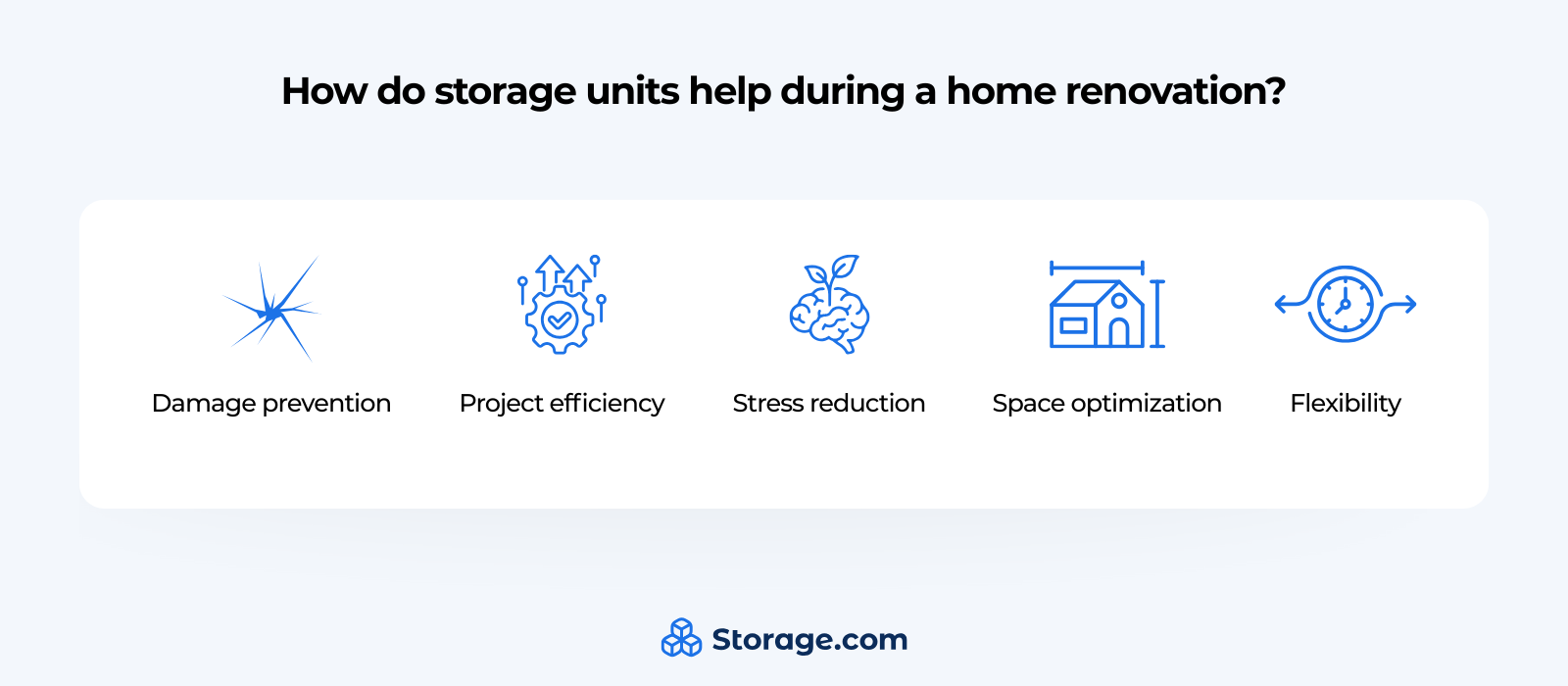
Renting a storage unit to keep your belongings in during a home renovation offers five benefits: damage prevention, project efficiency, stress reduction, space optimization, and flexibility.
- Damage prevention: Keeping items in a storage unit will keep them out of the way during a project and prevent them from being accidentally damaged.
- Project efficiency: DIY-ers and contractors alike will be able to get the work done faster if your belongings aren’t in the way.
- Stress reduction: Renting a storage unit will increase your confidence in the home renovation project and give you peace of mind that your home or belongings won’t be damaged.
- Space optimization: Extra space to store your belongings means extra space at home to get renovations done.
- Flexibility: Renting a storage unit allows you to switch out items over time if your home is undergoing a long-term, piece-by-piece renovation.
What storage options are available for home renovation needs?
Let’s break down the many types of storage you can use while renovating your home.
Traditional self-storage units
A standard storage unit is a secure space for you to store things in as long as you’re renting it. They’re good for many different situations, from short-term storage for a single room to long-term, climate-controlled storage for the delicate contents of an entire house.
- Pros: Convenience, affordable pricing, and widespread availability.
- Cons: You’ll have to move your belongings into the storage unit yourself, you’ll have to pay extra for some special features, and prices can vary wildly between states and cities.
- Typical pricing: $42-$129/month for a standard unit; $43-$153/month for a climate-controlled unit.
Portable storage containers
Portable storage containers such as PODS are extra storage spaces delivered directly to your home. You fill the container with the items you want to store, and you can then either keep the container with you or pay extra to have it moved to a storage facility. These containers are best for storing items that won’t be damaged by the weather.
- Pros: Even more convenient than storage units, flexibility to choose where you want the container to be stored.
- Cons: The container takes up space on a street or driveway, and portable containers are more expensive than storage units; even more so if you pay to have it moved to a facility. There aren’t many options for climate control.
- Typical pricing: Depends on the quote. Renting a container on its own can cost around $380/month; paying for a local move can cost around $3100.
On-site storage containers
On-site storage and shipping containers are similar to portable storage containers, but they’re typically larger and don’t offer an option to move off-site. These solutions are best for non-delicate items and the convenience of having an extra space right on your street.
- Pros: Convenience, larger size to store more objects, often cheaper than portable containers for more space.
- Cons: Shipping containers take up even more driveway or street space than portable containers, and climate control will cost you even more.
- Typical pricing: You can rent a non-portable storage container starting at $150/month.
Full-service moving and storage
Hiring a full-service moving and storage company to handle your storage needs for you is often pricier than storing things yourself, but doing so means you won’t have to worry about taking care of the process on your own. Full-service moving is best for situations where you want to keep your hands off and focus on other parts of the renovation.
- Pros: Convenience, peace of mind thanks to hiring a professional, and more freedom to focus on the home renovation tasks at hand.
- Cons: Often the most expensive option, and entrusting your belongings to other people can add an unwanted stressor.
- Typical pricing: You can pay anywhere from $720 to move a one-bedroom apartment to $5,640 to move the contents of an entire house. Storage costs can be anywhere from $40 to $150 per month.
How do I choose the right storage solution for my home renovation needs?
Selecting a home renovation storage solution will depend on the size of your renovation. For example, redoing a single room means you won’t need a large storage unit, so renting a small self-storage unit or portable container will be the best move. You also won’t need to rent the unit for as long if the renovation is small.
However, a multiple-room or whole-home renovation means you’ll need more space. If you’re doing the whole home at once, consider a full-service mover to handle your belongings or a large on-site container to keep the contents of your house in. Large self-storage units work in this case as well, but you’ll have to consider the costs and time it takes to move your stuff into it yourself.
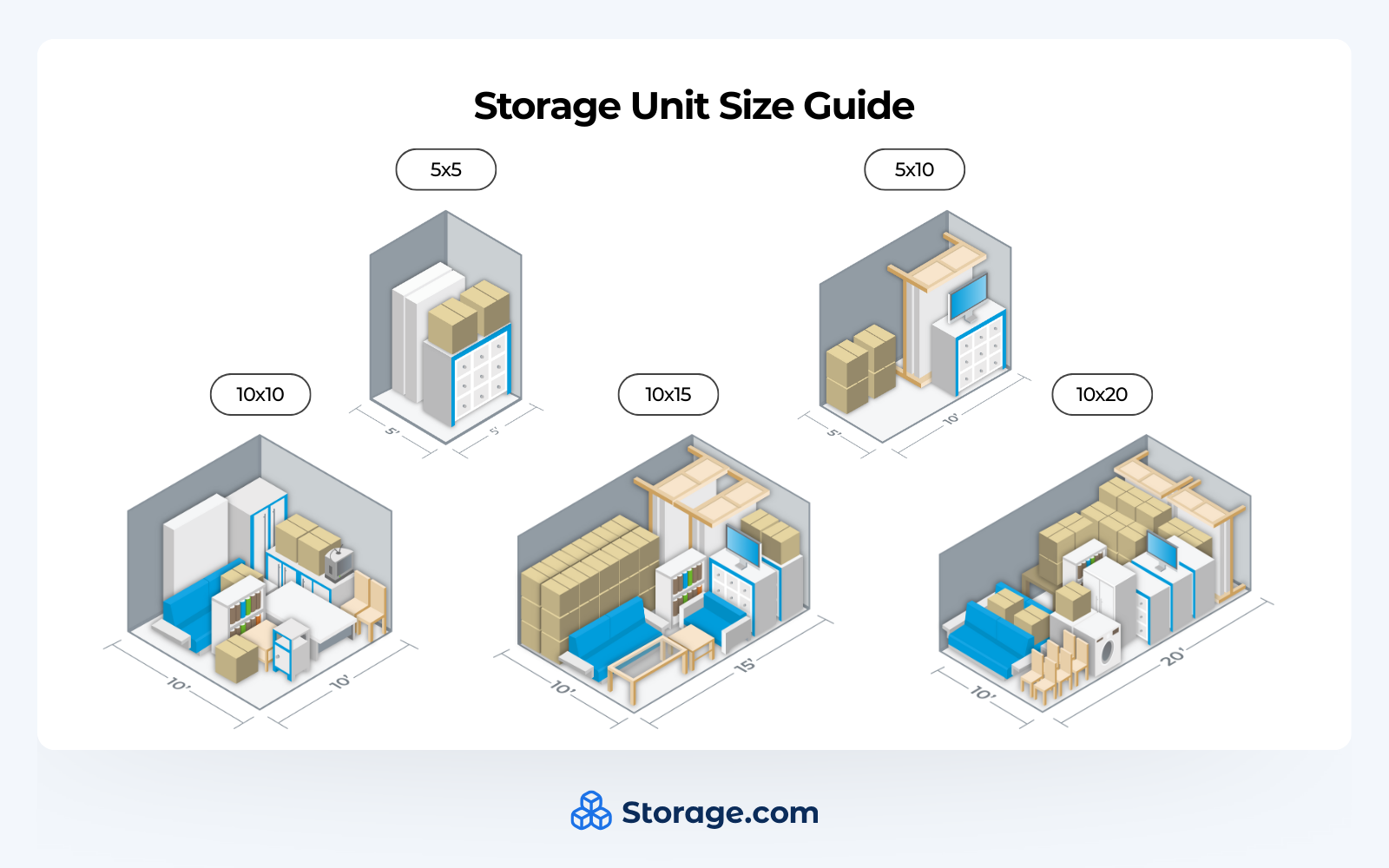
Here are a few common storage unit sizes alongside which rooms and homes they can fit the contents of.
| Storage unit size | What it can fit |
|---|---|
| 5′ x 5′ (25 sq. ft) | A walk-in closet |
| 5′ x 10′ (50 sq. ft) | A single bedroom |
| 10′ x 10′ (100 sq. ft) | A living room and two full bedrooms |
| 10′ x 15′ (150 sq. ft) | Three full bedrooms plus some larger furniture |
| 10′ x 20′ (200 sq. ft) | A small multiple-bedroom house |
What should I store during a home renovation?
When deciding what to store during a home renovation, focus on items that take up the most space and are the least delicate. Never store perishable items in a storage unit!
- High priority items: Large and durable furniture, such as tables and sofas.
- Medium priority items: Clutter, clothes, and anything else you may have that’s taking up smaller amounts of space. Anything that you may need climate control for.
- Don’t store: Perishable or volatile items, small items that you can easily store in another room.
How do I prepare items for home renovation storage?
Packing for storage is similar to packing for a move. No matter the size of the room or the number of items you’re storing, you’ll want to carefully organize everything and make the most of the space.
It’s easy and inexpensive to get cardboard moving and storage boxes that can fit your belongings. You should also have packing tape, cushioning material for delicate objects, and a marker to label your boxes with.
In each room, sort through everything and decide what you want to keep; other items can be sold, donated, or recycled. Pack items into boxes with care so you don’t have too much empty space in each box, and make a note of which boxes store which items. Clearly label each box with a general description of its contents and a FRAGILE note if it contains breakable objects.
To further protect those breakable objects, use bubble wrap or foam cushioning. You can also fill in empty space in fragile boxes with towels, sheets, or other fabrics to prevent impact damage.
Finally: never store heavier boxes on top of lighter boxes! This is a good way to crush and damage your belongings.
Do I need climate-controlled storage during a home renovation?
Climate-controlled storage is only necessary if you’re storing items that may be damaged or stained by temperature and humidity changes, and even more necessary if you live in an area with extreme heat, cold, or humidity. Complicated wooden items like instruments and antique furniture, delicate clothes, and electronics should all be stored in climate-controlled storage; it typically costs a bit more, but it’s a small price to pay to avoid repairs and replacements.
In contrast, if you live in an area with a relatively stable climate or you’re primarily storing household objects that are built to withstand temperature and humidity changes, you won’t necessarily need climate control.
When should I arrange home renovation storage, and what does the storage timeline look like?
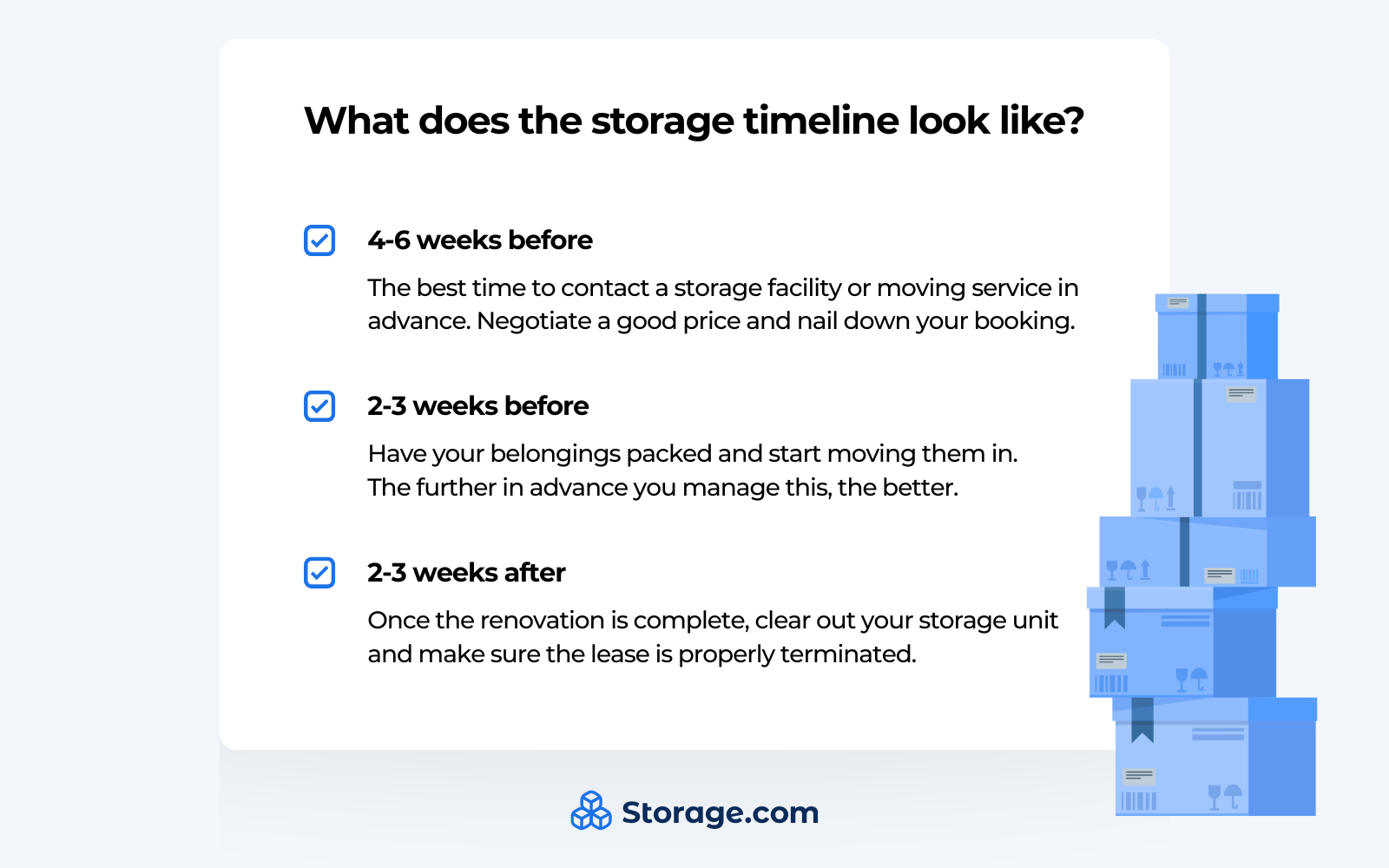
You should get in touch with your preferred storage solution four to six weeks before the renovation. Last-minute bookings will cost a lot more, and you run the risk of your preferred storage method not being available.
Here’s a quick glance at what you should expect and consider at each stage of the process.
- 4-6 weeks before: The best time to contact a storage facility or moving service in advance. Negotiate a good price and nail down your booking.
- 2-3 weeks before: If you’re renting self storage, have your belongings packed and start moving them in. The further in advance you manage this, the better.
- 2-3 weeks after: Once the renovation is complete, clear out your storage unit and make sure the lease is properly terminated.
How much does home renovation storage cost?
While self storage is the most cost-effective way to store your belongings during a home renovation, it all depends on size. Here’s a detailed chart of average storage unit monthly prices based on size:
| Storage Unit Size | National Average Rental Cost (March 2025-January 2026) |
|---|---|
| 5×5 | $33.31 |
| 5×10 | $51.75 |
| 10×10 | $84.13 |
| 10×15 | $110.51 |
| 10×20 | $131.86 |
If you’re hiring a moving service, you’ll end up paying much higher one-time moving costs in addition; renting a truck yourself to move things into storage will cost you much less. Save even more money by properly estimating how much space you need and rent the smallest unit that can fit everything.
How do I protect my belongings in storage during a home renovation?
If you’re worried about your belongings being damaged or stolen while you’re storing them, the best features to keep an eye out for are climate control to protect them from the elements, pestproofing to keep critters away, on-site security staff and surveillance cameras to keep a watchful eye on the facility, and gated entry to ensure only renters can enter the facility.
You may need to take out extra insurance on a storage unit in order to rent one. Luckily, the cheapest way to do this is asking your homeowner’s insurance provider to extend your coverage to the storage unit. You can also purchase separate insurance or built-in insurance from the storage facility.
An important tip: document the condition and position of all your items! This will make it easier to file a claim in the event something is stolen or broken.
What home renovation storage mistakes should I avoid?
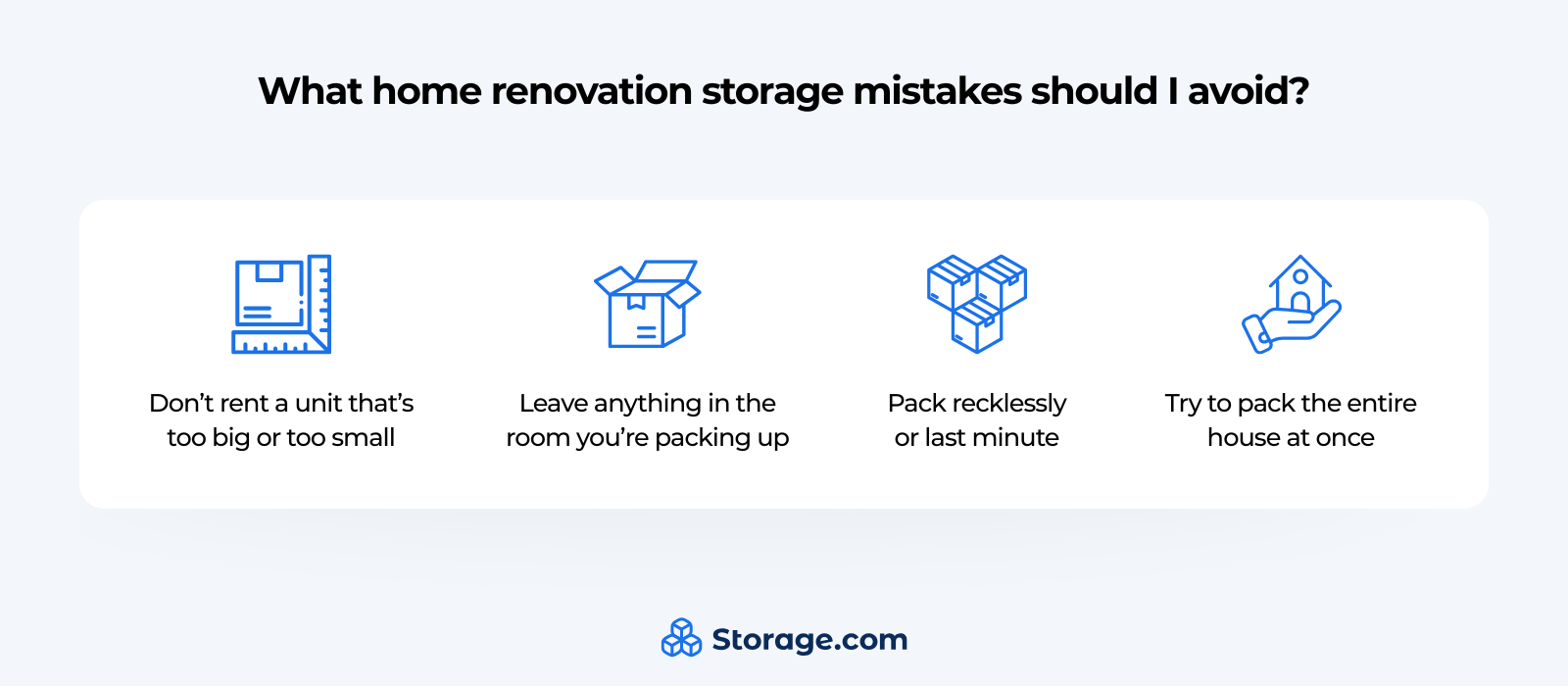
We’ve been over plenty of “do’s”, now let’s go over five important “don’t’s” when renting storage during a home renovation.
- Don’t rent a unit that’s too small. Changing unit sizes while you’re renting is possible but difficult, and you don’t want to learn the hard way you can’t fit all your belongings in a unit.
- Don’t rent a unit that’s too big. The space will be nice, and you want to leave some open areas to move through your unit, but you can waste money paying for space you don’t need.
- Don’t leave anything in the room you’re packing up. It can be easy to leave things behind, but properly sorting and packing every item in the room you’re having renovated will keep things out of the way.
- Don’t pack recklessly or last minute. Without enough time to properly organize and store everything, you can find yourself just throwing things into boxes. Dedicating time to packing and organizing will prevent damage and confusion down the line.
- For larger renovations, don’t try to pack the entire house at once. Pack and store one room at a time to help break down the process into smaller tasks. If you don’t focus on a single room at a time, you can easily get overwhelmed.
How do I find home renovation storage near me?
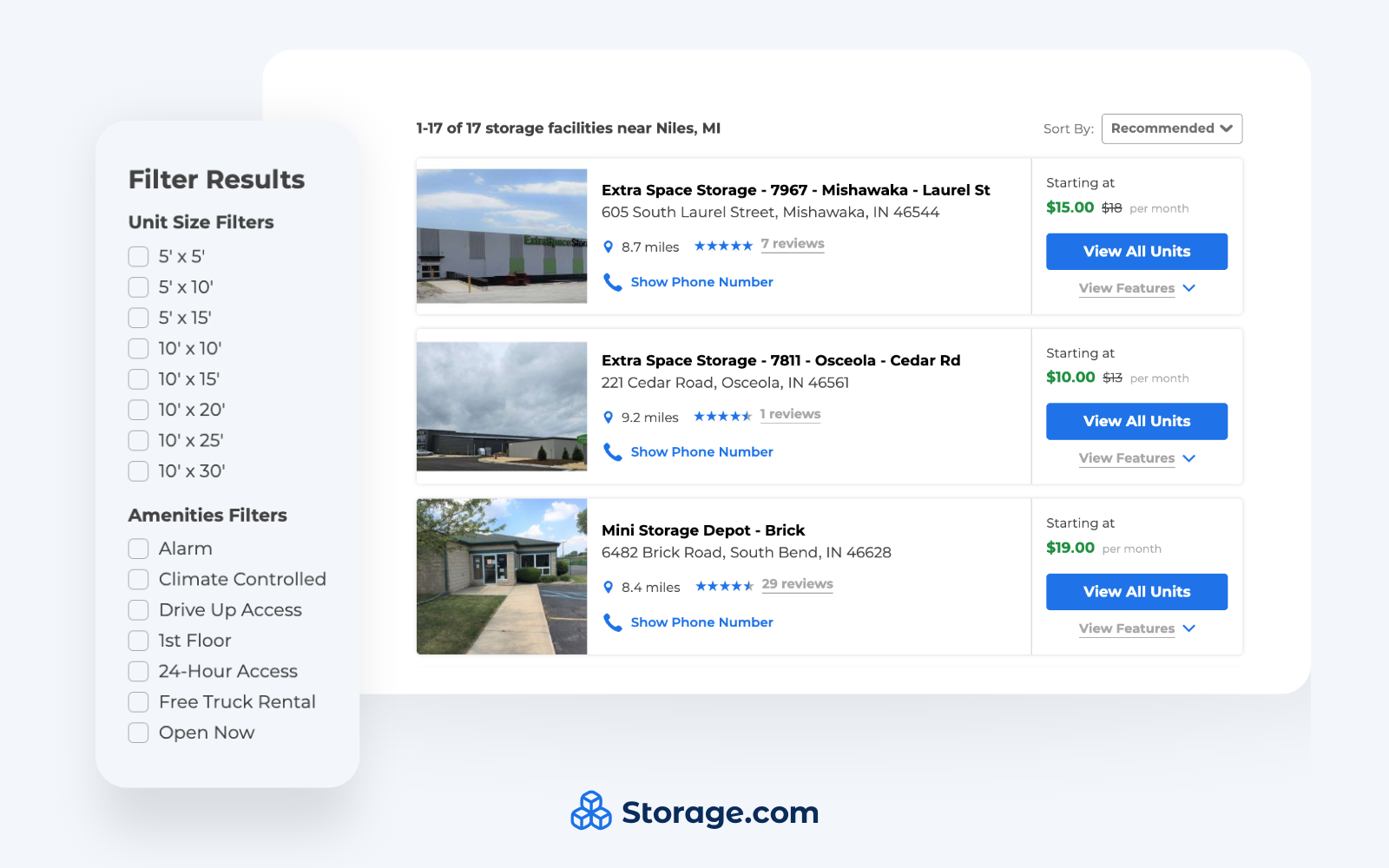
As it turns out, you’re in the perfect place to search for storage. Storage.com has a built-in search tool to help you see all the facilities near you with the features you want, and you can compare rental prices right next to each other. Booking through Storage.com can also net you a sizable discount.
When you’ve narrowed down your search to a couple of facilities, make sure you get in contact with them and visit the location to get a feel for the business. Ask the facility management about move-in and move-out procedures, what security and pest control measures they take, and what costs you can expect to pay. Dodgy answers to these questions, as well as uncared-for premises, are red flags to keep an eye out for.
What storage solutions should I look for in specific scenarios?
Living elsewhere during a renovation
If you don’t plan on staying in your home while it’s being renovated, look into renting self-storage units near your temporary residence. This will make it easier for you to check on the unit and make sure everything is in the condition it should be.
Renovating while living at home
If you plan to remain in the house during a renovation, whether it’s DIY or professional, look into renting a portable storage container. If you keep it on site, it’s the most convenient way to store your belongings without leaving your property.
Renovating in stages or phases
If your home renovation is large in scale but taking place in phases, rent a self-storage unit that leaves enough room for you to rotate things in and out. This way you can pack up your rooms ahead of time and swap out the storage unit’s contents as the work is completed.
Emergency renovations
If you’re in a time crunch to get a home renovation done quickly, it may be worth paying extra for a last-minute storage unit booking. Make sure you choose a facility that’s nearby to minimize the time it takes to move.
How should I move my items back once my renovation is complete?
Once you’re done with your home renovation, it’s time to move out of your storage unit. Make sure everything in the unit is in the condition you left it in, and make a note of any damage in case you need to file a claim.
Move the largest objects out first so it’s easier to position them in your renovated home, then move out the smaller objects to repopulate what space you have left. If you’re reorganizing your entire house, however, you may want to rent the storage unit for a little longer while you figure out where everything goes.
Rent a Storage Unit with Storage.com for One Less Thing on Your To Do List
Home renovations can be stressful, but finding the right storage solution during a renovation doesn’t have to be. From self-storage units to on-site containers, there are plenty of ways to save space in your home while it’s being fixed or upgraded, and it’s easier than ever to find those ways near you.
When you’re ready to get searching, head to Storage.com’s search tool to start making a list of facilities, and once you’ve decided on the facility you want, book through our site for a discount!