

Article takeaways
- Medical records can legally be stored in a storage unit, but only if the facility meets strict HIPAA security and privacy requirements.
- Storage facilities holding protected health information (PHI) must sign a Business Associate Agreement (BAA) with the healthcare provider.
- Security measures should include 24-hour surveillance, advanced access controls, auditable entry logs, and robust individual unit locks.
- Plastic bins or metal filing cabinets with locks offer better protection for paper records than standard cardboard boxes.
- Climate-controlled units are necessary to prevent paper deterioration from moisture, mold, extreme heat, or cold.
The ever-increasing volume of paper records and medical files can force a hospital, medical practice, or medical facility to shift toward electronic filing systems. But lots of health care providers still have backup hard copies on hand.
Health care providers usually have rooms in their buildings designated for storing sensitive medical records. But sometimes it’s necessary to transfer backup files to a temporary location due to renovations, construction, downsizing the office space, or moving to a new building.
But with shirnkflation at play, extra storage space within traditional office settings is harder to come by, so many healthcare providers explore external storage solutions. But you can’t just throw the sensitive patient information contained in medical records in a basement or garage.
Storing protected health information (PHI) outside the controlled environment of a medical facility until your medical office is ready requires meticulous attention to regulations, security, and long-term records management.
So, can you store medical records in a storage unit? The answer is yes, in fact a secure storage unit can be helpful for temporary medical document storage.
Instead of renting an entire warehouse, health care providers can rent a large storage unit to hold storage boxes and file boxes containing sensitive medical records.
Some storage facilities even specialize in document storage, utilizing security features, climate control amenities, and cleanliness to keep papers clean, legible, and secure.
This article covers the risks, requirements, and best practices for storing medical records in a storage unit.
Storage Unit Security for Medical Records
One of the most important things about storing medical records, whether they’re original copies or backups, is ensuring that only authorized personnel can access them.
Medical record security is governed by stringent federal regulations like the Health Insurance Portability and Accountability Act (HIPAA). The HIPAA Security Rule mandates specific administrative, physical, and technical safeguards to protect patient data and ensure patient privacy.
When considering a storage unit for records storage, the question isn’t just about the storage unit size, but about whether standard storage facilities can meet these critical security requirements.
You’re not just storing seasonal clothing or wooden furniture here. Business documents and medical records contain sensitive patient data like healthcare histories, patient privacy details, and confidential social security numbers.
Typical storage facilities employ security measures often include basic perimeter fencing, limited security cameras, and individual unit locks. But these measures rarely rise to the level required for safeguarding protected health information.
Or as Peggy Chapo, Director of Health Information Services for Botsford Hospital puts it,
“Every precaution should be taken to protect them. Access to files should be limited, using measures such as keypad entry, ID badge swiping technology, locked files, or biometric technology.”
You’ll need a more modern storage facility that may lack robust security protocols.
For example, electronic gates with personalized entry codes can serve as an extra security barrier, alarm-protected security doors on individual units, or comprehensive electronic monitoring via 24-hour surveillance cameras can help medical practices with safeguarding PHI.
Paper Document Storage: Storing Paper Medical Records in a Storage Unit
There are definitely situations where a medical practice finds that storing paper records in a storage unit for the short term is unavoidable. But there’s a way to go about it that maintains the safety and privacy of these physical medical records.
The stringent requirements of healthcare regulatory compliance experts like HIPAA may push the security limitations of most storage facilities. If this is the case, the medical practice will have to employ some of its own security strategies to supplement those offered by the storage facility.
- You should never leave documents containing someone’s private information sitting in the open, even if the storage facility has good security. Not only do you not want someone reading up on your patients, but an exposed document is also more vulnerable to dust, water, and other contaminants.
- You’ll want to store vulnerable paper records in durable, sealable storage boxes. Utilizing sturdy file boxes designed for document archival. Avoid flimsy cardboard boxes that can degrade and are more susceptible to damage.
- Rather than stacking these boxes on top of each other, you’ll want to organize them on metal shelving. A storage rack system can keep the boxes off the ground and prevent them from collapsing under each other’s weight.
A standard cardboard record storage box has dimensions of 10x12x15 inches and can easily hold 30 pounds of documents. But cardboard isn’t waterproof, so standard record storage boxes wouldn’t offer much protection if moisture or pests make their way in through the floor of your self-storage unit.
A 10×10 unit with shelving is capable of accommodating roughly 245 standard record storage boxes. Using the same kind of shelving, a larger unit, such as a 10×30, could potentially hold up to 735 boxes.
For additional protection, we suggest storing your documents in plastic bins instead of cardboard storage boxes. Just make sure the bin lids are snug so water can’t get in. You can also store and lock your paper documents securely in metal filing cabinets.
If the storage facility specializes in document storage, be sure to ask if they already have filing cabinets in their facility, and if the cabinet doors feature built-in locks.
Regardless of what type of container you decide to use to store medical records, it’s important to keep the information organized. Label each box, bin, or cabinet drawer for organization.
This will suit your convenience in case a patient’s medical records need to be accessed due to an unexpected event, such as a sudden glitch in the hospital’s medical record system, an upcoming appointment, or an emergency visit. The same convenience helps when it’s time to move the medical records back to the building.
HIPAA Requirements for Storing Paper Medical Records in a Storage Unit
Storing medical records in a secure storage unit is doable, especially in the short term. But any period of storage brings some challenges, the most fundamental of which is meeting the HIPAA requirement for security, including:
- Business Associate Agreement (BAA): Storage facilities are considered “business associates” under HIPAA if they store PHI. That means they require a written contract to define who can access the unit and how security is handled. Without this, the healthcare organization bears sole responsibility for any breaches.
- Security Standards: Records must be kept in a secure environment that is locked and off-limits to unauthorized individuals.
- Access Logs: HIPAA requires maintaining documentation, such as access logs and sign-out sheets for areas containing PHI.
This means the storage unit must be physically secure, with 24-hour surveillance, onsite security personnel, robust locks on the unit, and hardcore perimeter security around the facility itself. You need to take the risk of data security breaches and identity thieves into consideration.
Comprehensive security measures like constant surveillance, advanced access controls, and auditable entry logs ensure that the medical provider can prove that patient data was adequately protected while in the storage facilities.
So, while healthcare providers can technically place storage boxes of paper records into a self-storage unit, they’re not guaranteed compliance or adequate protection of protected health information. The medical practice has to be sure they’re prepared to take full responsibility for the document safety and patient privacy
Controlling Temperature and Humidity in Your Document Storage Unit
Paper records are highly susceptible to environmental factors. Without proper control over temperature and humidity, even securely stored documents can deteriorate rapidly, leading to illegible healthcare histories and the loss of critical patient data. If a medical practice is considering any form of off-site storage for medical records, the choice of storage facilities becomes critically important.
For starters, be sure the storage facility offers climate-controlled storage units. This technology is very popular in the storage industry because it allows storage units to be kept at a constant temperature between 55-85°F and maintains safe, carefully regulated humidity levels.
Watch this video to learn more about climate-controlled storage units:
Climate controlled storage units help maintain paper by controlling moisture and humidity. If the humidity is too high, the paper could become damp. Then, mold spores can sprout on the surface, covering or fading the text and posing health risks.
Extreme heat can cause paper to become brittle and inks to fade, while excessive cold can also damage paper fibers. By controlling the humidity levels in your storage unit, you can also prevent rust from developing on metal shelves and filing cabinets.
Even though you’d only be storing these documents in storage units temporarily, security and climate-controlled storage are absolutely necessary to ensure privacy and long-term record keeping.
Be sure to call storage facilities ahead of time to ask about their amenities. If they can guarantee proper conditioning, as well as secure access to stored medical records, their facility will serve as a good temporary home until your office has moved or your building’s construction or renovation has been completed.
Can You Store Medical Records in a Storage Unit: Storage.com Can Help
Now that you have all the facts, you can decide if a climate-controlled storage unit is the right choice for storing your medical records.
If you do choose to take the storage unit route, the first step is researching business-friendly storage facilities in your area that can serve as business associates.
You’ll want to come up with a realistic medical records organization strategy that doesn’t require you to miss out on too much work digging through bins and boxes.
But since there are no connections or installations required in a storage unit, it’s as simple as choosing a weekend, renting a moving truck, buying storage racks and filing cabinets, and lugging all your equipment into the unit and setting it up to your liking.
We covered all the essential office equipment and nice-to-haves for your paper document storage system. We suggest making an office furniture and equipment checklist and doing all your shopping at once. Once you’re set up, you’ve got a medical record storage space you can refine as your business needs grow.
And remember, amenities like climate control and enhanced security features are non-negotiable when it comes to safeguarding PHI against data breaches.
But not all storage facilities offer all these amenities. How do you find a storage unit that allows business and has everything you need to convert it into a comfortable and functional office space?
Lucky for you, Storage.com is here to help.
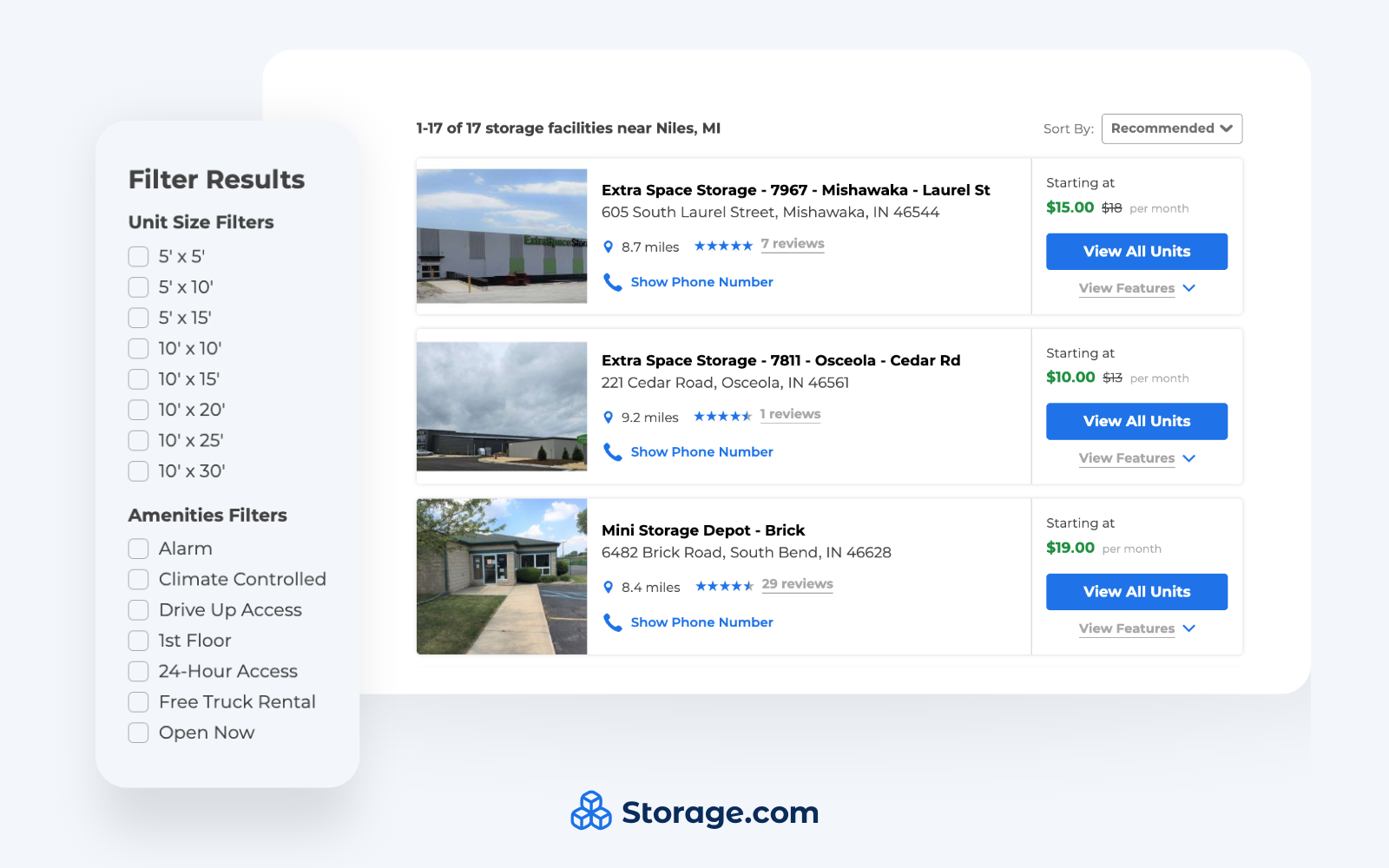
Storage.com lets you browse and compare storage units using amenity filters to find storage facilities in your area that offer the ideal features for medical records.
Just punch your zip code into our free Storage.com search tool, and you’ll see what we mean.
We’ll filter through the thousands of local storage facilities for you, making it easy to find the storage unit that best fits your medical practice’s needs.
Whether you’re looking for a storage unit with climate control, electricity, alarms, 24-hour access, drive-up access, or security cameras, Storage.com makes the process quick and painless. All you have to do is choose a storage unit and your move-in date, and we’ll take care of the rest. And if you have any questions about commercial or business storage that this guide didn’t answer, feel free to ask. Our storage representatives are just a phone call away!