
Article takeaways
- Whether you can park your RV in your driveway depends on state law, city ordinances, and HOA rules, and requirements are stricter in some cities than drivers expect.
- Most states that regulate driveway RV parking cap vehicle length at 40 to 45 feet, but local rules vary and should always be confirmed before you park.
- San Francisco introduced a stricter, citywide 2-hour limit on oversized vehicle parking in late 2025. Denver’s citywide 24-hour rule for RVs over 22 feet has been in effect since 2023, a detail the prior version of this article had missed.
- HOAs can restrict RV parking even where city and state law allow it, so read your governing documents before assuming your driveway is fair game.
- Dedicated RV storage protects against weather damage and sidesteps local parking crackdowns entirely, making it a more reliable option for long-term RV storage.
Owning an RV can be a gateway to years of road trips, adventures, and family memories. Between those adventures, though, where do you park it?
The question of the hour is: Can I park my RV in my driveway?
The short answer is: it depends. Every state has its own laws on RV parking on personal property, and many cities and HOAs layer on their own rules that are easy to miss if you don’t check them regularly. Before you assume your driveway works for oversized vehicle parking, check state, city, and HOA rules that apply to you.
This guide covers state-level regulations, the city rules most likely to catch drivers off guard in 2026, and what to do if parking at home isn’t an option.
What to Check Before Parking an RV at Home
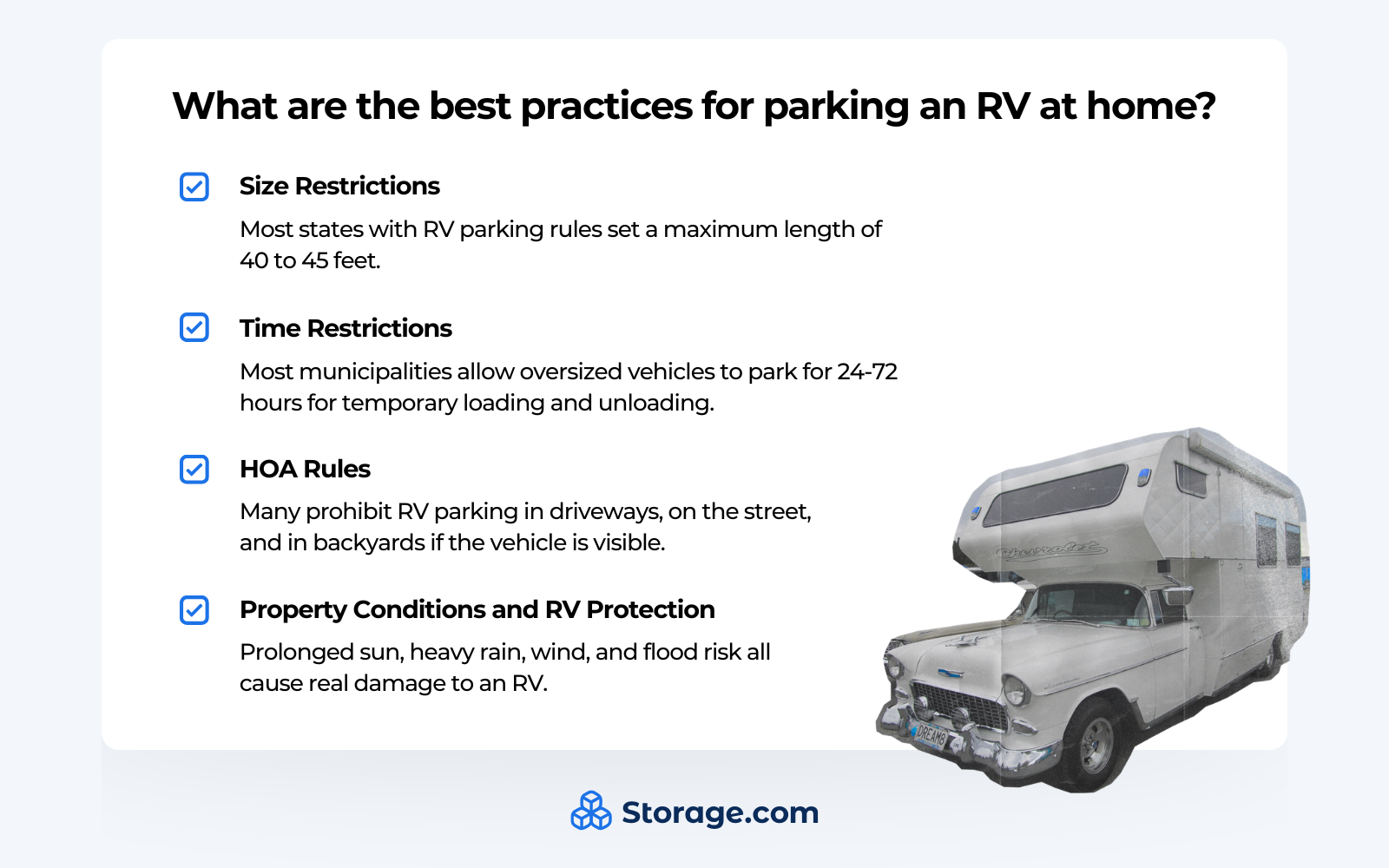
Before assuming your driveway works, check these four areas.
Size Restrictions
Most states with RV parking rules set a maximum length of 40 to 45 feet for driveway parking. If your RV falls within that range, you’re likely fine on size. If your unit is larger, or if it overflows your driveway onto the street, you may need to consider off-site storage.
Time Restrictions
Parking on the street? Time limits vary widely and have been getting shorter in some cities. Depending on where you live, oversized vehicles may be allowed to park for anywhere from 2 to 72 hours before a citation kicks in, and some cities require a permit even for short stays. Planning to leave it there for weeks or through the winter? That’s where fines start accumulating.
HOA Rules
HOA restrictions often go beyond state and city law. Many prohibit RV parking in driveways, on the street, and in backyards if the vehicle is visible from the street. Read your HOA agreement or contact your representative directly. Don’t assume you’re in the clear just because your city allows it.
Property Conditions and RV Protection
Even if the law permits it, your property may not be the right fit. Prolonged sun, heavy rain, wind, and flood risk all cause real damage to an RV. If conditions at home aren’t ideal, or you’re storing it long-term, it’s worth looking at other options, especially if you’re putting the vehicle away for the winter.
How Do RV Parking Regulations Differ by State?
States With Statewide RV Parking Restrictions
Here’s a brief overview of U.S. states with specific, statewide parking restrictions. City and residential rules may also apply in these states, so check local ordinances before parking your RV at home.
| State | Key Restriction |
|---|---|
| Alabama | Must stay at least 10 feet from the road |
| Arizona | Cannot extend over a sidewalk or street |
| Arkansas | Must be at least 15 feet from surrounding buildings |
| California | Driveway parking is temporary only |
| Colorado | Limited to driveways, side yards, or backyards |
| Connecticut | Rear or side driveways only; must sit closer to the front property line than the front wall of the home; 5 feet from the rear yard line |
| Delaware | Not permitted in driveways |
| Hawaii | Allowed if it doesn’t block public roads |
| Illinois | Must be at least 10 feet from the curb |
| Kansas | Must maintain required distance from the curb (varies by city) |
| Michigan | Must be 8 feet from a sidewalk and no longer than 45 feet |
| Montana | Driveway surface must be an approved material |
| North Dakota | Must maintain required setback from adjacent properties (varies by city) |
| Wyoming | Driveways must be at least 10 feet wide |
States Without Explicit Statewide Restrictions
The following states don’t have explicit statewide restrictions on RV parking, but local city or HOA rules often apply. Always verify before parking an oversized vehicle on your property:
Which Cities Have Stricter RV Parking Rules Than You’d Expect?
State-level compliance isn’t enough in some cities. Here’s where oversized vehicle parking rules are stricter than drivers often assume, including two updates worth knowing: San Francisco’s rule is new, and Denver’s has been in place longer than many people realize.
| City | Current Rule |
|---|---|
| San Francisco, CA | Large vehicles over 22 feet long or 7 feet tall face a citywide 2-hour parking limit, enforced 24/7. (Effective November 2025) This replaced the city’s older overnight-only rule; Mayor Daniel Lurie signed the ordinance in July 2025. A Large Vehicle Refuge Permit offers a limited exception for residents transitioning out of vehicle living. |
| Denver, CO | RVs, campers, and trailers over 22 feet are limited to 24 hours of parking within any 7-day period, citywide across all zones, and must relocate at least 700 feet to reset the clock. This rule has been in effect since May 2023. |
| Seattle, WA | Vehicles over 80 inches wide can’t park anywhere in the city between 12:00 a.m. and 6:00 a.m., unless it’s a commercial vehicle in an industrial zone. A separate citywide rule bars any vehicle from sitting on the same block for more than 72 consecutive hours. |
| New York, NY | Generally prohibits RV parking for more than 24 hours, and the city’s tight streets and heavy traffic make it a difficult place to navigate in an RV regardless. |
| Phoenix, AZ | Vehicles over three-quarters of a ton, including most RVs, can’t stand or park on residential streets except while actively loading or unloading. |
Cities continue to revisit these ordinances, particularly in response to vehicle-based homelessness, so it’s worth checking your destination city’s current code before a long stay, not just assuming last year’s rule still applies.
What Are Your Options If You Can’t Park an RV at Home?
Even if you’ve confirmed you can legally park your RV in your driveway, you may not want to. Leaving an RV outside for a long stretch while you aren’t using it can lead to weather damage, dirt buildup, and internal wear if you skip routine maintenance.
To help protect your RV and avoid costly repairs, consider renting space at a dedicated vehicle storage facility. Here’s how the two main options compare:
| Storage Type | Pros | Cons |
|---|---|---|
| Outdoor RV parking lot | Lower monthly cost; simple drive-in access | Minimal protection from sun, rain, and wind |
| Covered or indoor RV storage | Full protection from weather; often includes added security | Higher monthly cost than outdoor lots |
If saving money on RV storage is the priority, an outdoor lot is a reasonable choice. If you want to keep your RV in the best possible shape long term, indoor or covered storage is the stronger option.
How to Find RV Storage Near You
Parking an RV in your driveway can be complicated, and in some states and cities, it’s outright against the law. For the best results, look for an RV storage facility where you can rent space and keep your RV secure for the long term.

The TLDR on Parking Your Camper or RV in Your Driveway
So, can I park my RV in my driveway? In many places, yes, at least temporarily, but state, city, and HOA rules all play a role, and some cities enforce stricter limits than most drivers expect.
Check your local ordinances, read your HOA agreement, and consider your RV’s exposure to the elements before deciding where to keep it long term. When home parking isn’t an option, a dedicated RV storage facility keeps your investment protected and out of the way.