
Article takeaways
- RVs come in a wide range of sizes. The average RV is 20-35 feet long, but the full spectrum ranges from 8-foot teardrop trailers to 45-foot Class A motorhomes.
- RV widths are standard and consistent. Most RVs measure the legal highway width of 8-8.5 feet wide, but hydraulic wall slide-outs can add another 2-3 feet when deployed.
- Don’t overlook the height. At 10-13.5 feet tall, Class A motorhomes and fifth-wheels require thoughtful route planning to ensure your RV will clear bridges. They also cannot fit standard home garages.
- Listed dimensions usually don’t include extra features or add-ons. Manufacturer specs typically exclude hitches, roof-mounted equipment and modifications. Always measure your actual RV buildout before booking a campsite or storage.
- Consider length, height and width when choosing a storage unit for your RV. Match the unit’s length to your RV’s total footprint, ensure your RV can fit within the unit’s drive-up clearance, and always add 2-3 feet to your RV’s length for easy ingress and egress when it’s parked inside your unit.
Average RV sizes are 20-35 feet long, 8-8.5 feet wide and 10-13 feet tall. However, exact dimensions vary widely by class: Class A motorhome sizes stretch up to 45 feet long, while teardrop trailers can be as short as 8 feet. Your RV’s total dimensions determine where you can park, how you can store it and on which roads you can safely and legally drive, thus it’s critical to know your vehicle’s total size, down to the centimeter.
Many owners find out the hard way why RV sizes are so important. A campsite that looks accommodating on a booking app might actually cap out at an unsuitable actual footage for the size of your vehicle. A covered storage facility might have a 12-foot canopy clearance that’s fine for most RVs, but too short for a tall Class A. A standard home garage may be convenient, but the height of most motorhomes exceeds the 7-foot garage door clearance.
Before booking a campsite or storage, understanding how tall, wide and long your RV actually is, including any extras and add-ons plus a few additional feet for easy entry, gives you options, saves you money, and prevents major headaches during crucial moments when you’ll need this very specific information.
RV Dimensions by Type — The Complete RV Size Chart
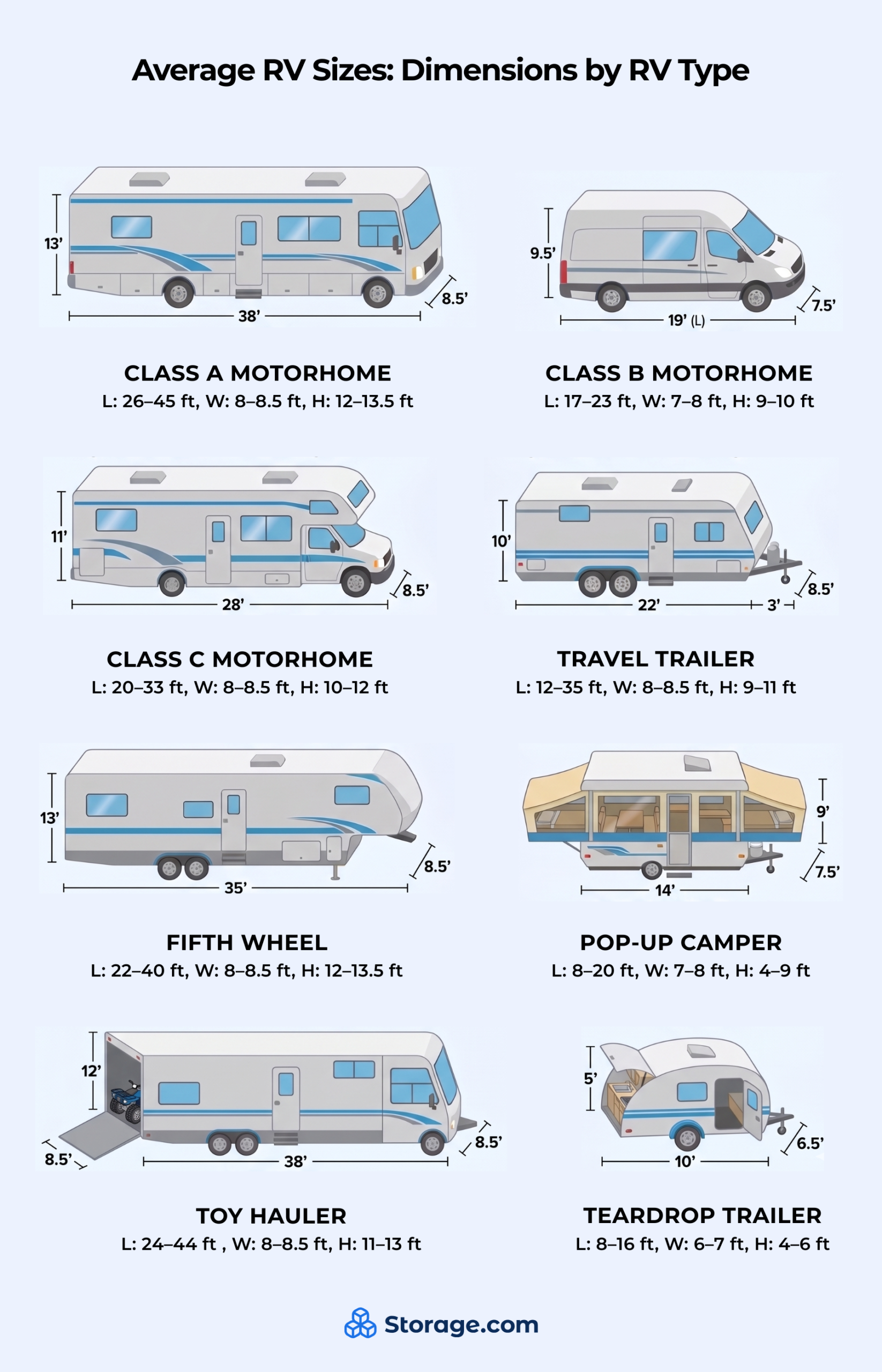
Every RV type has its own dimensional footprint, determined by its chassis, floor plan and intended use. The RV size chart below covers the eight most common average RV sizes, from ultra-compact teardrop trailers to full-sized Class A motorhomes.
Recommended storage unit sizes for each are also included.
Average RV Dimensions by Type:
| RV Type | Length | Width | Height | Rec. Storage Unit |
|---|---|---|---|---|
| Class A Motorhome | 26–45 ft | 8–8.5 ft | 12–13.5 ft | 10×30 – 10×45 |
| Class B Motorhome | 17–23 ft | 7–8 ft | 9–10 ft | 10×20 – 10×25 |
| Class C Motorhome | 20–33 ft | 8–8.5 ft | 10–12 ft | 10×25 – 10×35 |
| Travel Trailer | 12–35 ft | 8–8.5 ft | 9–11 ft | 10×15 – 10×35 |
| Fifth Wheel | 22–40 ft | 8–8.5 ft | 12–13.5 ft | 10×25 – 10×40 |
| Pop-Up Camper | 8–20 ft | 7–8 ft | 4–9 ft | 10×10 – 10×20 |
| Toy Hauler | 24–44 ft | 8–8.5 ft | 11–13 ft | 10×30 – 10×45 |
| Teardrop Trailer | 8–16 ft | 6–7 ft | 4–6 ft | 10×10 – 10×15 |
Class A Motorhome Size
Class A motorhomes are the largest and most feature-rich RVs on the road today, ranging from 26-45 feet in length, 8-8.5 feet wide and 12-13.5 feet tall. Their size comes from full-chassis construction, which allows for generous floor plans, hydraulic slide-out rooms and amenities equal to those found in small apartments.
However, their standard height of over 13 feet can create challenges for clearing low bridges, gas station canopies and standard covered storage. Class A motorhome sizes do best in indoor or outdoor storage spaces sized between 10×30 and 10×45 feet.
Class B Motorhome Size
Class B motorhomes, also popularly known as camper vans, are built on a standard van chassis. This makes them among the most maneuverable motorized RVs available. They range from 17-23 feet long, 7-8 feet wide, and 9-10 feet tall. Their compact size makes them perfect fits for city streets and standard parking lots. Class B owners also enjoy more accessibility to campsites and encounter fewer restrictions on bridges and urban areas than their more robust counterparts.
The convenience and accessibility of the camper’s length and width on the road comes at the sacrifice of the far more spacious interior living space found in the Class A. Class B campers offer all-in-one efficiency accommodations for 1-2 people, with features equivalent to those found in a tiny studio apartment.
Class B motorhomes fit well in storage units as small as 10×20–10×25 feet.
Class C Motorhome Size
The average Class C motorhome is 20-33 feet long, 8-8.5 feet wide, and 10-12 feet tall. Class C motorhomes are built on a cutaway truck or van chassis, and are recognizable by the over-cab sleeping loft that extends over the driver’s area. This loft gives the Class C its extra height, and it’s an important measurement to keep in mind when pulling into a gas station, garage or booking a storage unit where your RV’s clearance may be an issue.
Length depends on the floor plan. Shorter 20-foot models are ideal for couples or smaller traveling parties, while the longer 33-foot models with slide-outs and full-sized amenities work well for families or larger groups who need more space on the road.
Storage units totaling 10×25-10×35 feet are ideal for the C Class RV.
Travel Trailer Size
Travel trailers offer the most variety in RV sizes, spanning from compact 12-foot units to luxurious 35-foot models. Widths maintain the standard 8-8.5 feet, with heights averaging 9-11 feet.
A key note not to be overlooked with travel trailers is their listed length does not include the hitch tongue, which typically adds another 2-4 feet to the total tow length. Failing to account for this extra footage could mean being turned away at site entrances, so be sure to add your travel trailer’s extra tow footage to any total parking, camping or storage space your travel trailer requires.
Travel trailer storage units typically range in size from 10×15 for a small weekender to 10×35 for the largest models.
Fifth Wheel Size
Fifth wheels are towable RVs that connect to a specialized truck-bed mounted hitch. This hitch gives them a more stable tow profile than conventional travel trailers. The average RV size for a fifth wheel ranges from 22-40 feet in length, and 8-8.5 feet wide, but height is the real stand-out here. Fifth wheels feature an elevated front section that sits above the driver’s area, similar to but even taller at 12-13.5 feet than that found in the Class B motorhome.
Fifth wheels offer capacious, residential living with a small apartment feel. They’re great for extended trips and longer-term living on the road. However, their extra height is a clearance concern for below bridges and standard-height entryways.
Fifth wheel owners typically choose outdoor storage over covered units to accommodate their height. Storage unit size for fifth wheels depend on the total RV length, and typically range between 10×25-10×45 feet.
Pop-Up Camper Size
Pop-up campers are lightweight canvas RVs that collapse for easy storage, making them easily the most compact and storage-friendly RVs available. Fully set up, pop-up campers range from 8-20 feet long, 6-7.5 feet wide, and expand to 9 feet tall.
The low-fuss convenience of pop-up campers makes them an extra entry point for those new to camping, or road-trippers seeking the convenience of an RV without the hassles of clearance and storage. Standard pop-ups feature surprising amenities for the convenient form factor, including sleeping quarters, a kitchenette, electrical hookups and a 12V water pump.
Pop-up campers fold down to 4 feet or less in height for easy indoor storage. A 10×10 or 10×20 storage unit provides plenty of pop-up camper storage, with no clearance concerns.
Toy Hauler Size
Toy haulers are RVs that feature a rear cargo garage and ramp. They’re designed to carry recreational equipment such as ATVs, motorcycles and side-by-sides. This means they run large, between 24-44 feet long and 11-13 feet tall.
They’re available as travel trailers or fifth wheels, with many models including convertible, multifunctional living spaces. While many owners use toy haulers for transport, RV sizes can be used as workshops, offices or outfitted for luxury dwelling.
Because the cargo area adds both length and height, most toy haulers need a storage unit of at least 10×30 feet, with at least 12 feet of clearance height. See our truck and trailer storage guide for more on hauler storage requirements.
Teardrop Trailer Size
Teardrop trailers are compact, lightweight campers that are typically 8-16 feet, 6-7 feet wide and 4-6 feet tall when closed, with a nostalgic, retro design and name that reflects their shape. They are designed to be easily towed by almost any vehicle, and make camping accessible to people who don’t own a truck or large SUV suitable for towing larger RV sizes.
Teardrop trailers are built for minimalist, weatherproof RV road-tripping and camping. Many models include a two-person sleeping cabin and a kitchenette–think elevated tent camping. Some models are built for rugged off-roading, while other designs are perfect for cozy glamping.
Teardrop trailers’ small size fits into almost any standard vehicle storage unit or garage. A 10×10 or 10×15-foot storage unit is more than enough for most teardrop trailers.
Explore more RV storage options to find the right fit.
How Slide-Outs Affect RV Width
Most RV listings do not include the size of slide-outs in their stated widths. An expanded slide-out adds 2-3 feet or more to the total width of an RV. You’ll need to know how wide a camper is before booking a campsite or camping pad, and before renting a storage unit.
While slide-outs should be retracted when your RV is in storage, your unit should accommodate the total RV size with slide-outs extended to ensure full vehicle access while in storage, should you need it. Check the slide-out extended width in your owner’s manual before booking anything that is RV-size dependent.
How to Find & Measure Your RV’s Exact Dimensions
Many RV owners know only their vehicle’s listed length, which often excludes attachments, accessories and modifications that change the vehicle’s real-world fit. This is a common source of confusion for RV owners, but it’s also one of the easiest to address.
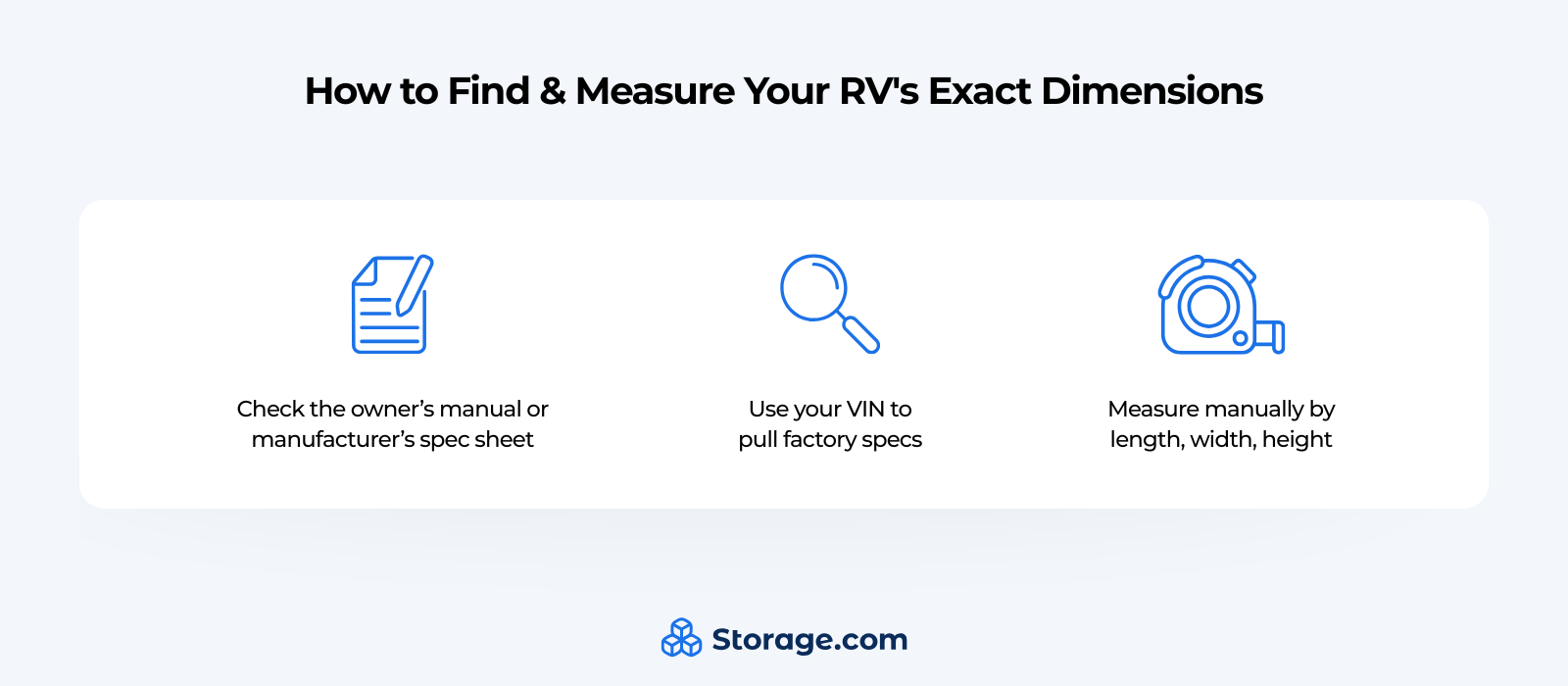
We’ve listed the three reliable methods for finding your RV’s exact measurements below, from fastest to most thorough. Unmodified motorhome sizes will be reliably noted in the vehicle’s user manual. But if you’ve made additions or mods, you’ll want to measure manually. Use the method below that matches your situation, and keep your numbers handy to help avoid unexpected complications on the road:
Method 1: Check the Owner’s Manual or Manufacturer’s Spec Sheet
The owner’s manual lists factory dimensions for length, width and height, and is the fastest, most accurate source to find an unmodified RV’s size.
Method 2: Use Your VIN to Pull Factory Specs
Your RV’s Vehicle Identification Number (VIN) provides factor specs through free decoders at NHTSA.gov, Carfax or JD Power. This is especially handy if you’re buying a used RV that lacks its original paperwork. Be aware VIN-based specs reflect unmodded RV sizes, so any changes made by a previous owner will not be included. If this matches your situation, you’ll want to go with Method 3.
Method 3: Measure Manually
Use manual measuring for RVs that have been outfitted with exterior equipment or features, such as bike racks, roof-mounted equipment, extended bumpers, awnings or solar panels. Here’s how to do it:
- Length: Measure from the front bumper, or the front of a tow vehicle’s hitch). Include the hitch tongue for travel trailers, and the rear bumper for motorhomes.
- Width: Measure from the widest point on the body. Take measurements with and without slide-outs and mirrors extended.
- Height: Measure from the ground, past the roofline if necessary to the highest fixed point on the roof. Include any racks, A/C units, roof vents or satellite dishes.
Remember to re-measure your RV anytime you make a new roof-mounted addition or any other exterior modification. A standard rooftop solar panel raises your RV’s height 3-5 inches, which might seem insignificant until you’re facing a bridge with low clearance.
Finally, as you sort out how wide your camper is, or how long your RV is, here’s what you should know about exterior vs interior dimensions as well.
The manufacturer’s specs list exterior dimensions. Interior dimensions usually refer to usable headroom and are consistently shorter. Roof structure, insulation layers and mounted equipment usually account for a 1-2 foot difference between the exterior roof height and the actual interior standing clearance.
Why RV Dimensions Matter — Practical Implications
RV sizes determine where you can go and what your experience will be, so it’s critical that you know the exact dimensions of your rig. Here are a few ways your RV’s exact length, width and height can impact your travel:
Campsite and RV Park Selection
Most campsites post a maximum RV length, which is typically 40 feet, and sites with utility hookups have defined pad lengths. Larger RVs have significantly fewer campsite options, particularly in national parks where many campsite pads are capped at 19-30 feet.
Bridge and Tunnel Clearance
RV sizes that exceed 13 feet tall need an active route planning strategy to ensure low clearances at gas stations, parking garages and bridges don’t catch Class A and fifth wheeler drivers off guard. RV-specific GPS apps like Garmin RV, CoPilot Truck and RV LIFE Trip Wizard account for RV size and height, and will automatically route you around low-clearance obstacles.
Garage and Carport Fit
A standard residential garage door is 7 feet tall and 8-9 feet wide, which excludes the vast majority of motorhome sizes, including all Class A RVs, most C Class RVs and many Class B camper vans with roof equipment. Pop-up campers and teardrop trailers are among the few exceptions that are compact enough to fit inside almost every home garage.
For most RV owners, a dedicated storage unit is the most practical long-term solution, and matching your RV’s exact dimensions to the right unit size is the key to avoiding damage and overpaying for more than you need.
RV Dimensions & Self Storage — Finding the Right Fit
Once you know your RV’s exact dimensions, finding the right storage solution for your RV size is straightforward, so long as you know what to look for. There are three types of RV storage: uncovered outdoor, covered outdoor, and indoor / enclosed. Let’s walk through them:
- Uncovered outdoor storage is the most convenient and is suitable for almost all RVs. RV length, width and local laws are among the few potential limitations with outdoor storage, so make sure your planned location has enough usable space to park your vehicle for long periods, and ensure parking RVs in places like driveways is allowed in your area.
- Covered outdoor storage is another popular, affordable choice that features a canopy that protects motorhomes from UV and weather damage. Height can be a constraint, so make sure the canopy is high enough to clear your RV if you’ll be using an existing covered outdoor storage space.
- Indoor / enclosed storage usually offers drive-up convenience and the best protection from weather, pests and theft. Note that indoor storage typically caps at 10 feet, which eliminates most Class A and Class C motorhome sizes unless the facility has RV-specific tall bays.
Use the RV size chart below as a guide to choosing the right unit for your motorhome:
Storage Unit Size by RV
| RV Type | Recommended Unit | Storage Type Notes |
|---|---|---|
| Teardrop Trailer | 10×10 – 10×15 | Indoor or outdoor; minimal height concern |
| Pop-Up Camper | 10×10 – 10×20 | Indoor-compatible when folded |
| Class B Motorhome | 10×20 – 10×25 | Indoor-compatible at most facilities |
| Travel Trailer (small) | 10×15 – 10×25 | Outdoor or covered; confirm tongue length |
| Class C Motorhome | 10×25 – 10×35 | Covered/indoor needs 12 ft+ clearance |
| Travel Trailer (large) | 10×25 – 10×35 | Outdoor or covered |
| Fifth Wheel | 10×25 – 10×40 | Covered needs 12–13 ft clearance |
| Toy Hauler | 10×30 – 10×45 | Outdoor or tall indoor only |
| Class A Motorhome | 10×30 – 10×45 | Outdoor or RV-specific tall bays |
Always add 2-3 feet to how long your RV is before you select a unit, to make sure you have enough room to comfortably move around and access your RV, and to allow for safe door clearance when entering and exiting the unit in your vehicle.
Check out our maxi storage guide for detailed information on oversized storage options at facilities that specialize in housing large vehicles, or visit Storage.com’s storage locator to find RV storage facilities in your area.
RV sizes and dimensions vary widely by type and class, but they all come down to just three numbers: length, width and height. Knowing all three is essential before you drive, park or store your motorhome anywhere that’s new to you.
The difference in footage between a Class B camper van and a Class C motorhome shouldn’t be dismissed; this determines whether your RV stores best indoors or outdoors, squeezing into a campsite or being turned away due to size, and comfortably clearing low overhangs vs driving through on a hope and a prayer.

Once you’ve nailed down your RV’s exact dimensions, you’re ready to find a storage facility that can actually accommodate your motorhome’s size–and this is where we come in. Storage.com’s facility locator is free to use with no credit card required. Browse, filter and select units by location, size and amenities to find the storage setup that fits your rig.