
Article takeaways
- Storage insurance coverage is not required. Most facilities don’t legally require insurance, but many include mandatory clauses for proof of insurance in their rental agreements, and some facilities may encourage you to purchase in-house plans.
- Storage unit insurance rates average between $6 – $10+ per month. Your actual price will depend on myriad factors, including your facility’s location, amenities, coverage limits and the total value of your stored items.
- Basic storage unit coverage usually protects against the basics. Fire, vandalism, theft and some water damage are usually covered, but flood, pest and normal wear and tear protection are typically excluded.
- Homeowners or renters insurance may cover a small percentage of your policy value. Coverage is usually capped at 10% of your total personal property limit, and coverage applies to common threats like fire, vandalism and theft.
What Is Storage Insurance Coverage, and Do You Need It? Breaking Down the Costs and Considerations for Extra Protection
What is storage unit insurance?
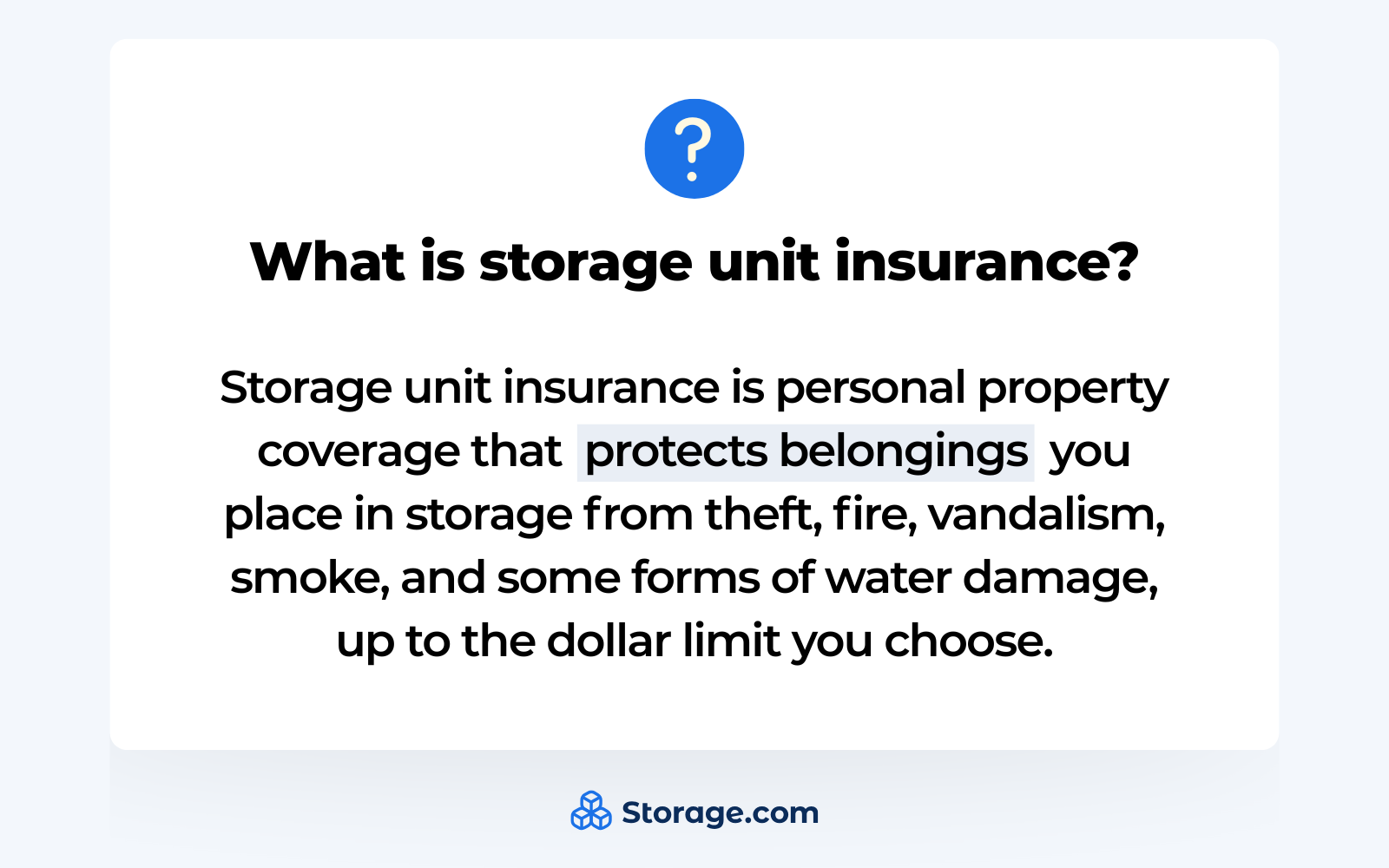
Storage unit insurance is personal property coverage that protects belongings you place in storage from theft, fire, vandalism, smoke, and some forms of water damage, up to the dollar limit you choose.
In many places, storage unit insurance works much the same way homeowner’s insurance works for your home, but instead applies to personal items stored inside your off-site storage unit. Storage unit insurance usually comes with its own limits, exclusions, and deductibles.
Who needs storage insurance coverage?
Storage unit insurance is for you if you think you would struggle to pay out of pocket to replace your stored items if they were lost to irreparable damage. You will also need it if your storage facility requires it as part of your unit’s rental agreement.
People most often purchase storage unit insurance when they are storing seasonal items, valuable items, business inventory, or household items during a move. If, for any reason, you cannot afford to lose items you have in storage, storage unit insurance is a must to ensure your items and your wallet are protected should the worst occur.
How much does storage unit insurance cost in 2026?
Most policies in 2026 allow you to select coverage amounts in increments of $1,000 and up, at a monthly cost averaging $10 – $40+. Expect to pay higher rates in some states due to rising claim costs and extreme weather.
What Factors Affect Storage Unit Rates? Why Costs May Vary
Storage insurance is priced based on location, provider type, coverage limit and the value of your stored items. Higher coverage limits command higher monthly rates, because the insurer is responsible for a bigger payout should something go wrong.
The total value of the things you store also impacts your price, due to the potential severity of the cost of the loss. Insuring high-value items like business inventory or expensive personal items costs more than coverage for lower-value household goods.
You should expect to pay higher rates in areas prone to higher risk. Locations vulnerable to natural disasters like floods, heavy storms, or wildfires will come with higher premiums. Coverage will also cost more in high-crime areas that are more prone to theft and break-ins than facilities located in lower-risk areas.
Providers price their own plans, so the type of provider you choose will also determine your rate. Compare rates for your facility’s plan, third-party specialty coverage or homeowner’s extension coverage to get the best deal.
Deductible size and optional add-on coverages for extras like pest or water damage protection may also raise or lower your premium, depending on the ratio between what you buy vs what you choose to cover yourself.
Common Events, Exclusions, and Other Important Details: Know What Is and Isn’t Covered by Storage Insurance
Storage units are generally safe, but that doesn’t mean they’re impervious to life and all that comes with it. Standard storage unit insurance coverage typically includes fire, smoke, vandalism, theft, and some forms of accidental water damage not related to flooding or leaks. Some policies may also cover certain types of storm damage and natural disasters, so it’s important to read your policy carefully if protection from these issues are important to you, or if your storage facility may be susceptible to them.
Most storage insurance coverage excludes pest or mold damage, normal wear and tear, damage such as poor packing that can be attributed to the renter, and mysterious disappearances you can’t prove were stolen. Policies may cap at high-value items like jewelry, fine art, cash, and certain types of business documents.
Make sure you read your policy’s fine print before signing to determine if it works for your needs, or if your storage requires additional riders for comprehensive coverage.
Is Storage Insurance Coverage Mandatory? Understanding Rental Agreement Requirements

Do all storage units require insurance? Legally, there is no legal requirement that mandates all rental customers carry storage unit insurance in every situation.
However, many facilities require or strongly encourage coverage as part of the rental agreement. Facilities that do mandate insurance often include a clause in the rental agreement that states you must either show proof of insurance or purchase their in-house plan.
Other storage facilities allow you to rent without a policy, but may encourage you at sign-up to purchase their preferred coverage. If you decline, you may be asked to sign a waiver that relieves the facility of any responsibility for damage, theft or loss of your property. Skipping coverage means accepting all risk in case of a loss.
If you are renting a storage unit, it is best practice to consider insurance as part of the total cost, even if it’s optional. Be aware that the facility’s own liability contract for damage to your items heavily favors them, not you. If your belongings are worth storing, they are worth protecting.
Average Coverage Costs by Type: A Guide to Storage Unit Insurance Costs
Storage unit insurance coverage is usually offered by the storage facility itself, your homeowners’ insurance policy if applicable, and third-party insurance providers.
Facility-provided standard insurance in 2026 averages between $10-$30+ per month, for $3,000 – $10,000 worth of coverage. These plans are good choices for renters seeking convenience, because they can be added at check-out when renting a unit.
Most homeowners or renters’ insurance includes 10% of your total personal property coverage for items stored off-site, so a policy that provides $50,000 in coverage will extend $5,000 in coverage for your stored items at no additional cost. These policies tend to be the most cost-effective coverage, but make sure you know your policy’s limitations.
Many third-party providers offer specialized, standalone storage insurance coverage with limits up to $25,000+ per unit for monthly rates starting around $10. These policies are typically more flexible, with higher insurance limits.
If you’d rather skip contracts, premiums and commitments, you can always go the self-insurance route and rely on cash reserves. You’ll save on monthly premiums, but keep in mind this method exposes you to cover the full replacement cost should disaster strike.
Facility Insurance vs Third-Party Insurance: Making the Cost-Conscious Choice
The short answer is third-party storage unit insurance rates, which start at $10+ per month depending on the coverage amount, are often cheaper for high-value coverage than storage facility coverage. Third-party coverage works best for long-term rentals because billing and cancellation can be less convenient than other types of coverage.
Facility coverage averages $10 – $15+ per month and is ideal for shorter-term rentals thanks to its simplicity. These plans are designed for flexibility, and are easier to immediately activate, change or cancel.
Be sure to compare claims processes for these options. Third-party services may require more documentation and coordination with you in exchange for stronger, more responsive claims processes, while facility coverage may offer less convenient but more streamlined claims procedures.
You May Already Be Covered: Homeowners and Rental Insurance Coverage for Off-Site Storage
Many homeowners and renters insurance policies automatically provide off-premises storage insurance coverage, but this coverage is usually limited to 10% of your total personal property limit. Thus, if your policy covers $75,000 in personal property, a policy with a 10% limit would cover $7,500 of storage unit insurance cost. This may or may not be enough to cover the value of your stored goods, so review your policy carefully to make sure it is sufficient for what you need.
Homeowners or renters insurance is a good option for storage insurance because it can save you from overspending on storage insurance rates. It’s also a good option for those who don’t want the hassle of managing a separate policy, and works well if you need minimal or short-term coverage for storage items.
Review your policy or contact your insurance agent to verify if coverage is offered and what limits and requirements apply.
Don’t Overpay or Under–Insure: Choosing the Right Amount of Storage Insurance Coverage
An inventory of your items will help you determine the total amount of storage insurance coverage you should consider. Focus on the replacement cost of each item you have earmarked for storage, which may be different from what you originally paid. Use this total to select a coverage limit that meets or slightly exceeds it, and factor in any policy caps on specific categories like electronics or collectibles. This process will ensure you don’t under- or over-insure your goods.
- Storage used for business or commercial inventory may require commercial storage insurance, which commands higher limits with different terms that will be reflected in your total storage unit insurance cost.
- Short-term storage of lower-value items may be suitable for modest coverage. Longer-term storage or high-value storage is worth the extra spend and peace of mind that higher storage insurance coverage provides.
Save on Storage Insurance Coverage: Savvy Strategies to Reduce Your Rate
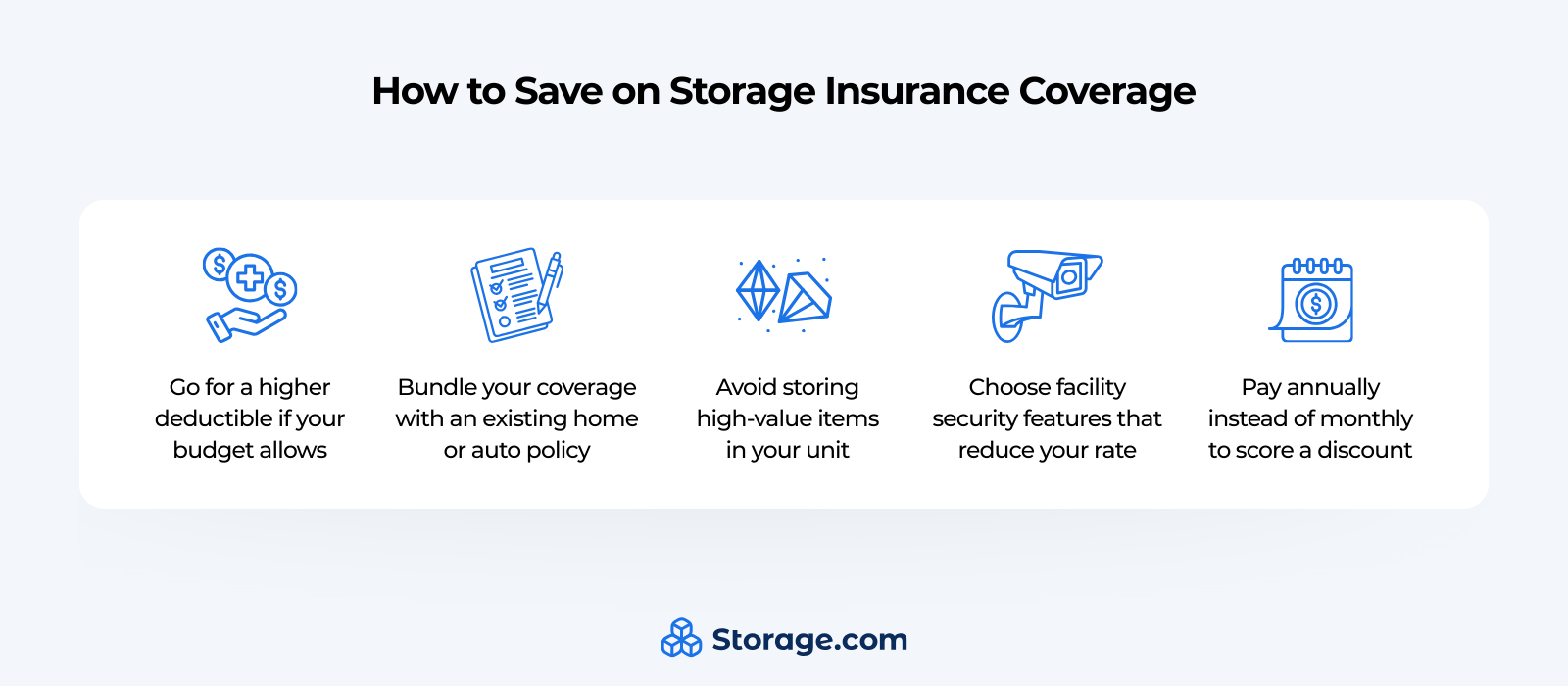
If you’re looking for ways to save on your storage unit insurance cost, we have you covered. Below are a few ways you could reduce your rate and save on costs:
- Go for a higher deductible if your budget allows. This will reduce the insurer’s potential payout and will resultantly lower your monthly premium. Note, however, this means you assume more risk.
- Bundle your storage insurance coverage with an existing home or auto policy. This could trigger a multi-policy discount.
- Avoid storing high-value items in your unit, to keep your total coverage amount low. Consider safely stashing precious or expensive items at home instead.
- Choose facility security features that reduce your rate, such as 24/7 surveillance, gated entry, unit alarms or climate control.
- Pay annually instead of monthly to score a discount on your entire year’s premium. Yearly discounts average 10%, so be sure to ask your provider about any available policy discounts.
Uncovered: The Financial Risks of Skipping Storage Insurance Coverage
If you opt out of storage insurance coverage, you assume the responsibility and out-of-pocket costs for anything damaged or lost should something go wrong. Most storage facility contracts limit the facility’s liability for customers’ personal property. This means you can’t rely on them to reimburse you for losses, even if the damage occurs on their premises.
Consider this real-world scenario: A 2024 storage facility fire in Phoenix left more than 40 uninsured renters with almost $900,000 in combined losses and zero compensation, while insured renters received full replacement value for their lost goods.
If the thought of such a loss gives you chills, the cost of monthly storage unit coverage is probably more than worth the peace of mind to ensure your off-site, out-of-sight goods are covered in the event of disaster.
Choosing Storage Insurance Coverage: Estimate, Evaluate, and Decide
Storage unit insurance cost varies widely, based on your needs, chosen provider and the value of your stored items. For many people, the average monthly investment of $10+ per month is more than worth it for the peace of mind storage insurance coverage provides.
Don’t commit to storage unit insurance coverage before you’ve compared your relevant options and gathered quotes from several providers. Doing so will ensure you have chosen the right coverage at the best price to protect the value of your personal goods.
If you’re in the market for an affordable storage unit, let us help you locate a storage unit facility near you.