
Article takeaways
- Most passenger cars are 14 to 17 feet long, 5.5 to 6.5 feet wide, and 4.5 to 5 feet tall.
- Vehicle class is the biggest variable — a crew-cab truck can be 8 feet longer than a subcompact.
- A 10×20 storage unit fits most standard passenger cars. Larger vehicles need a 10×25, 10×30, or 10×40.
- Always measure your specific vehicle before booking — trim levels and packages affect dimensions.
- Width and height matter as much as length. Account for door swing and overhead clearance.
Most cars are between 14 and 17 feet long, about 6 feet wide, and 4.5 to 5 feet tall. But dimensions vary significantly by vehicle type — and knowing your car’s actual size is the first step to finding a storage unit that fits.
This guide covers average car length, width, and height by vehicle class, plus which storage unit size works for each.
Average Car Dimensions by Vehicle Type
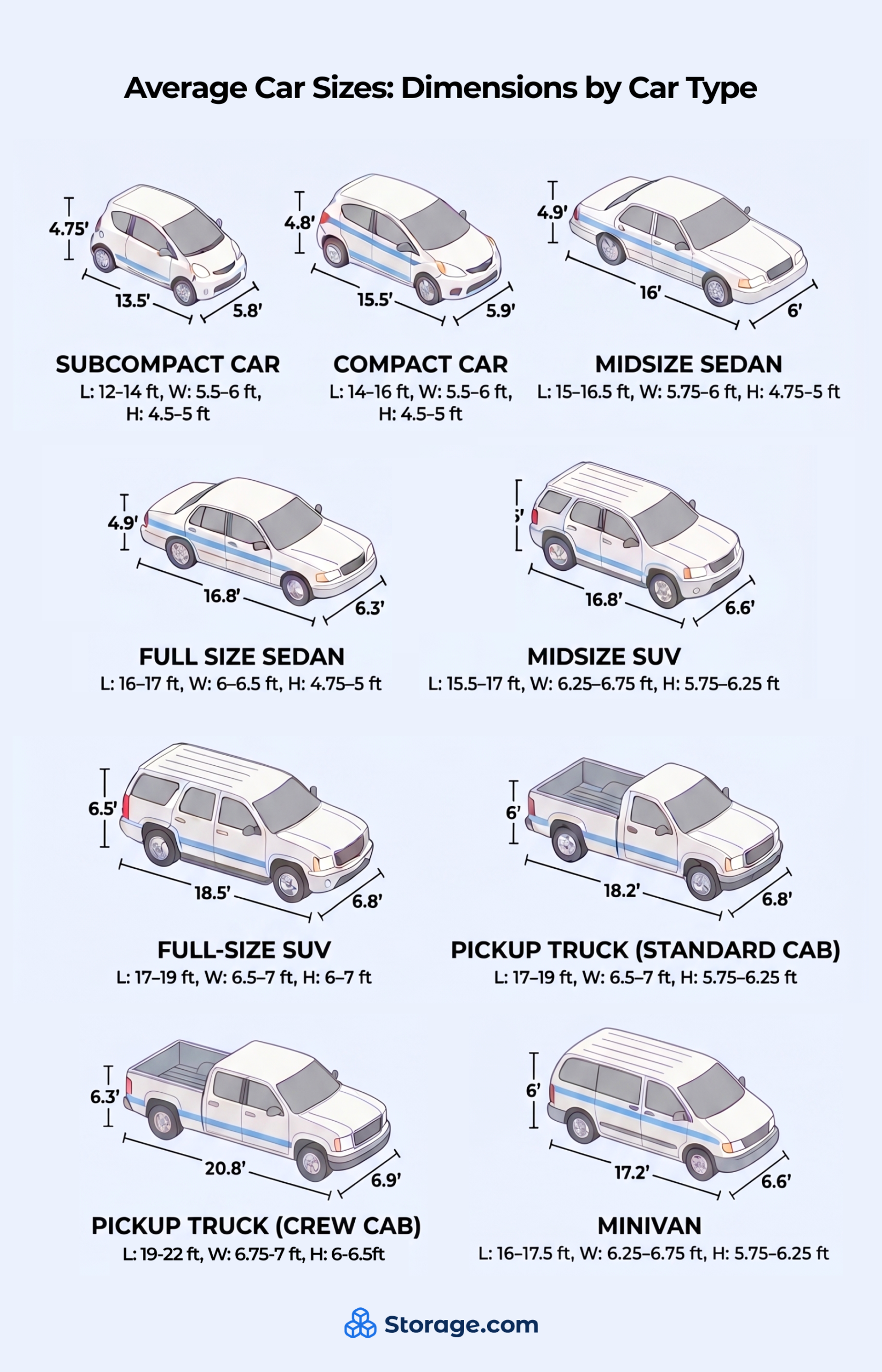
Car length, width, and height vary widely across vehicle classes. Here’s what to expect for the most common types, and what size storage unit you might need for your car:
| Vehicle Type | Common Vehicles | Length | Width (body) | Height | Recommended Storage Unit |
|---|---|---|---|---|---|
| Subcompact car | Honda Fit, Chevy Spark, Kia Rio, Toyota Yaris | 12–14 ft | 5.5–6 ft | 4.5–5 ft | 10×20 |
| Compact car | Honda Civic, Toyota Corolla, Mazda3, VW Jetta | 14–16 ft | 5.5–6 ft | 4.5–5 ft | 10×20 |
| Midsize sedan | Honda Accord, Toyota Camry, Nissan Altima, Hyundai Sonata | 15–16.5 ft | 5.75–6 ft | 4.75–5 ft | 10×20 |
| Full-size sedan | Chrysler 300, Dodge Charger, Toyota Avalon, Nissan Maxima | 16–17 ft | 6–6.5 ft | 4.75–5 ft | 10×20 |
| Compact SUV | Honda CR-V, Toyota RAV4, Ford Escape heavy Equinox | 14.5–16.5 ft | 6–6.5 ft | 5.5–6 ft | 10×20 |
| Midsize SUV | Toyota Highlander, Ford Explorer, Kia Telluride, Honda Pilot | 15.5–17 ft | 6.25–6.75 ft | 5.75–6.25 ft | 10×20 |
| Full-size SUV | Chevy Suburban, Ford Expedition, GMC Yukon, Cadillac Escalade | 17–19 ft | 6.5–7 ft | 6–7 ft | 10×25 or 10×30 |
| Pickup truck (standard cab) | Ford F-150, Chevy Silverado, Ram 1500, Toyota Tacoma | 17–19 ft | 6.5–7 ft | 5.75–6.25 ft | 10×25 or 10×30 |
| Pickup truck (crew cab) | Ram 1500 Crew, GMC Sierra Crew | 19–22 ft | 6.75–7 ft | 6–6.5 ft | 10×30 or 10×40 |
| Minivan | Honda Odyssey, Toyota Sienna, Chrysler Pacifica, Kia Carnival | 16–17.5 ft | 6.25–6.75 ft | 5.75–6.25 ft | 10×25 or 10×30 |
Dimensions are approximate averages. Confirm your vehicle’s exact specs before booking. Width figures do not include extended side mirrors.
What Affects Car Size
The vehicle class is the primary driver. A subcompact and a crew-cab truck can differ by nearly 10 feet in length. Within a class, trim level and configuration also matter, a long-bed truck is several feet longer than the same model in a short-bed.
Side mirrors add to effective width. Most vehicles gain 12 to 18 inches when mirrors are extended. That matters when sizing a storage unit door opening or planning clearance inside the unit.
Roof additions raise effective height. Cargo boxes, roof racks, and lift kits can add several inches or more. Standard storage unit doors run 8 to 10 feet tall, which clears most stock passenger vehicles — but verify before booking if your vehicle has any roof-mounted additions.
How Car Dimensions Map to Storage Unit Sizes
Once you have your vehicle’s dimensions, matching it to a unit is straightforward:
- 10×20: Fits most sedans, hatchbacks, and compact SUVs under 17 feet. The most common choice for standard passenger cars.
- 10×25: Better fit for full-size sedans, midsize SUVs, standard cab trucks, and minivans.
- 10×30: Suitable for full-size SUVs, most crew-cab trucks, and extended-cab pickups.
- 10×40: Best for the longest crew-cab trucks, oversized vehicles, or situations where you need storage space alongside the vehicle.
A unit that’s slightly longer than your car isn’t just a luxury — it gives you room to open the doors, walk around, and access the vehicle without risk of damage.
Climate Control and Drive-Up Access
For long-term or seasonal car storage, a drive-up unit simplifies getting the car in and out. If you’re storing a classic car or leaving a vehicle for an extended period in extreme temperatures, climate-controlled storage limits exposure to heat, cold, and humidity.
How to Measure Your Car for Storage
Your owner’s manual and the manufacturer’s website are the most accurate sources. If you need to measure manually:
- Length: Bumper to bumper in a straight line.
- Width: Widest point of the body, mirrors folded — then again with mirrors extended.
- Height: Ground to the highest fixed point (roofline, antenna base, or roof rack).
Compare all three against the unit’s interior dimensions and door opening before booking.
Bottom Line
The average car is roughly 14 to 16 feet long, about 6 feet wide, and 4.5 to 5 feet tall. Larger vehicles — full-size SUVs, minivans, crew-cab trucks — push well past those numbers. A 10×20 unit handles most standard passenger cars; anything bigger typically needs a 10×25 or larger.
Before booking car storage, measure your vehicle’s length, width (with mirrors), and height. Those three numbers are all you need to find a unit that fits without guessing.